ROQUES DE LOS MUCHACHOS OBSERVATORY
Monday, 3rd March
Introduction
This was an earlier start than usual at 09:45 as we had a long drive up to the Roques de los Muchachos (Rocks of the ‘Chaps’) Observatory for a tour of the telescopes. The observatory is at the highest point of the island at nearly 8000ft (2426m) overlooking the Caldera de Taburiente.
This was not strictly a geology day but the site itself and the drive to it afforded much of geological and botanical interest. We were lucky to have Sheila as our guide for the day as she had previously worked as a software engineer on one of the telescopes. She had met her husband there and he is still working there as an engineer. Consequently we had a well informed and knowledgeable guide.
The Drive Up (Agriculture, Botany & Meteorology)
The drive from Santa Cruz de la Palma was memorable if only for it’s 200+ hairpins! We were able to get good views of the countryside and vegetation. Sheila explained that the original cash crop introduced after the Spanish conquest was sugar cane and tobacco. While tobacco is still grown the main crop is bananas which can be seen anywhere and everywhere you look. Prickly Pear Cactus was also introduced to encourage the Cochineal Beetle from which red dye is made. Potatoes (actually a tropical plant) are also widely grown as on the other Canary Islands. Bees are also farmed for honey. Almost every flattish piece of land is cultivated with pocket handkerchief fields in the most inaccessible places.
We drove up through a thickly forested region with Chestnuts, Pines, Broom and Tree Heather. In particular we passed through one of the last remaining Laurel forests. As the trees began to thin out at around 1500m patches of snow began to appear at the roadside. Snowfall only usually occurs in occasional winter tropical storms and this does not happen every year. The general weather pattern is dominated by the nearly permanent Azores anticyclone. This creates a stable NE ‘Trade Wind’ which is present for about 300 days a year. The result is that the NE of the island is generally cloudy as the humid NE wind is forced to rise over the central spine of the island. The cloud spills over the central spine to form spectacular ‘Cloud Waterfalls’ on the western side. This western side is consequently much drier and sunnier; the change as you drive from East to West across the ridge is quite dramatic!

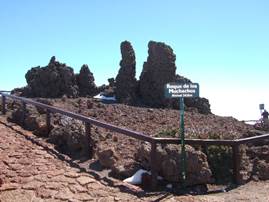
Cloud Waterfall Roques de los Muchachos
The Observatory
This weather pattern combined with the height of the Taburiente volcano has created an ideal site for the observatory. There is also a natural temperature inversion with height and this traps any dust and water vapour under a capped cloud layer which can be seen thousands of feet below. In addition the airflow over the site is laminar (smooth) with minimum turbulence which minimises atmospheric optical distortion.
The observatory site was first explored in 1960 to test its viability as an observing site. Initially a road had to be built from Santa Cruz to the site. The new road followed the path of an old donkey track which led up to an ‘Ice House’ where winter ice was stored and brought down daily for sale, mainly to preserve fish. The number and type of telescopes has gradually built up since then and is now home to some 17 instruments operated by a number of countries including Spain, Germany, UK, Sweden, Norway, Belgium, Mexico and Denmark. The total number of staff is over 170 and it contributes around €4.2 million per annum to the local economy. It is one of the most important observatories in the world. Foreign telescopes pay site rent in ‘telescope time’. 75% of this time is awarded to the ‘best proposed’ programme as judged by committee and 25% is ‘international’ time. All the telescope time is well oversubscribed.
The telescopes perform different measurements across different parts of the electromagnetic spectrum at Infra Red, Visible Light, Ultra-Violet and Gamma –Rays. Most telescopes either record a conventional image using a CCD array or record the spectrum of the ‘light’ using a spectrometer (either a fixed grating or a Fabry-Perot Etalon). However gamma-rays cannot be observed directly as they are absorbed by the atmosphere. In this case they are observed indirectly by the characteristic blue light flashes (Cherenkov radiation) emitted as the Gamma-Rays collide with atmospheric gas molecules.
The functions of the various telescopes can be summarised as follows:
- CILBO (Netherlands) Meteors (in conjunction with Izaña on Tenerife)
- SuperWASP (UK) Exoplanets
- ATC (Spain) Accurate star positions
- DOT (Netherlands) Solar observations
- KVA-60 (Sweden) Exoplanet atmospheres and teaching
- SST Sweden Solar convection cells (70km resolution)
- JKT (UK) Non-operational
- SQT (Northern Ireland) Exoplanet follow up to SuperWASP
- Mercator (Belgium/Swiss) Long term measurements on variable objects
- Liverpool Telescope (UK) Robotic general purpose optical
- Isaac Newton (UK) Moved from Herstmonceux in 1984. Wide field
- NOT (Norway) Polarimetry
- TNG (Italy) High resolution spectroscopy
- WHT (UK) Near Infra-red spectroscopy
- GTC (Spain/Mexico) Largest optical and IR on site. Faint distant objects
- Magic (International) Gamma Rays using Cherenkov radiation
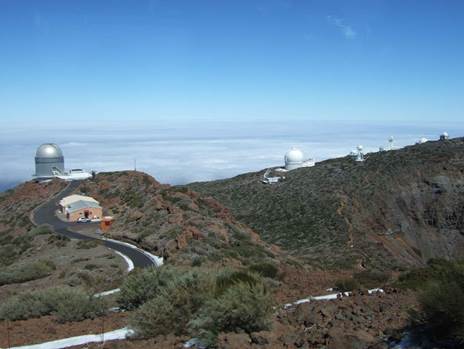
General View of the Observatories
There have also been laser experiments conducted between the La Palma observatory and Tenerife to study ‘Quantum Entanglement’ of photons over long distances. This is a seriously weird effect in Quantum Physics where pairs of photons appear to ‘know’ instantaneously when one of them has been ‘measured’. It is being used to create unbreakable encryption techniques for information transfer.
Sheila gave us a guided tour of the GTC (Gran Telescopio Canaria) and the MAGIC Telescopes.
The GTC is the biggest visible optical telescope in the world. The main mirror is 10.4 metres in diameter and is made up of 36 x 2 metre hexagonal segments. It was inaugurated in 2009. Each hexagonal mirror is accurate to 15 nanometres. This would mean that if the mirror was the size of mainland Spain the deviation from true would only be 1.5 cms! The total weight of the telescope is 385 tonnes and it ‘floats‘on a high pressure oil bearing.
The telescope collects the same amount of light as 4 million human eyes! This means it can see very dim and distant objects at the edge of the visible universe.
The main mirror is built up of hexagonal segments rather than one thick piece of glass. This allows the mirror to be very much lighter and reduces the distortion that would occur with a solid mirror as it moved form horizontal to vertical. Even this residual distortion is corrected by 3 computer controlled pistons on each segment.
The main mirror and sub-reflector form a cassegrain optical system using a Ritchey-Chrétien arrangement where both main and sub-reflector surfaces are hyperbolic. This eliminates coma and spherical aberration and gives a wide field of view at the expense of astigmatism. It is interesting to note that this is exactly the same optical system used on the Hubble Space Telescope
There are three kinds of detector at the telescope foci. The optical detector is a large CCD array cooled with liquid nitrogen (-170 deg C) to reduce electrical noise. There is also an optical spectrometer (grating and Fabry- Perot Etalon) for measuring the wavelength of the light as well as atomic absorption lines. The infra red detector has to be cooled to liquid helium temperatures (-265 deg C). The GTC is capable of seeing and analysing the light from very distant regions of the observable universe. The most distant object analysed so far is 13,000 million light years away. This can be compared to our closest star (Proxima Centauri) which is a mere 4 light years away!
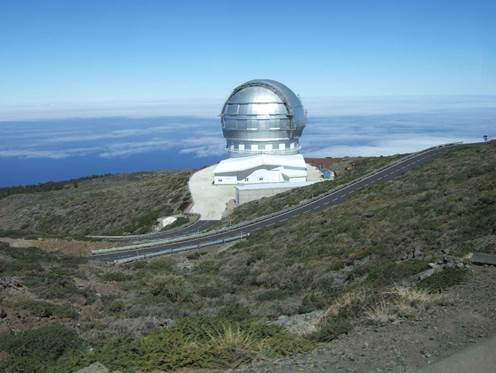
Gran Telescopio Canaria (GTC)
The MAGIC Telescope is a gamma-ray telescope. Gamma rays are not detected directly but instead the faint blue light produced when gamma-rays collide with air molecules is detected. This light is known as Cherenkov radiation. The MAGIC assembly consists of two 17 metre diameter telescopes with square segmented primary mirrors. The accuracy and quality of the optics does not need to be anywhere as good as the GTC and a dome is not needed. It would be too expensive anyway! The mirrors are just cleaned by the very occasional rain!
Gamma-ray bursts from, for example, exploding stars are unpredictable and only last for a few minutes. Wider angle low sensitivity instruments detect the onset of a burst and MAGIC has to rapidly rotate to catch it. For this reason it can do 180 deg in 40 seconds!

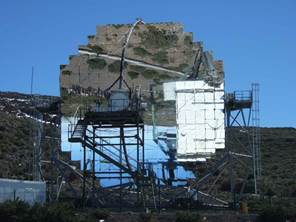
MAGIC (View of both telescopes) MAGIC (Close-up) - We are imaged top left!
Geology
Our lunch stop at the Roques de Los Muchachos was at the viewpoint which afforded excellent views of the walls of the Taburiente Caldera. In particular several of us noted a particular eroded Eastern face which was covered in a vast network of intrusive magma Dikes and Sills extending thousands of feet vertically and horizontally. When looking at it one could imagine it continuing into the rock in 3D. What struck us was that most of the Dikes and Sills were contiguous and connected with sections which ran at all kinds of angles to the horizontal and vertical. The question we posed was when does a Dike become a Sill and vice-versa?

Dikes or Sills?
We were invited by Geoff to look out for ‘Periglacial Features’shown on the geological map, on the first part of the drive down. In spite of the best efforts of the whole party we were unable to spot any. We did however observe evidence of the amazingly high erosion rate of the terrain. On closer inspection there was plenty of evidence of pyroclastic flow material as well as basaltic lava. This manifested itself as quite soft and crumbly yellowish rock which was being rapidly eroded. There were rock falls at regular intervals along the road even though Sheila told us that they were cleared weekly.
Tailpiece
One of the more famous experimenters at the observatory has been the guitarist Brian May of ‘Queen’. He was unusually allowed to finish his PhD on Zodiacal Light after a break of decades. That’s what fame does for you!
Further Reading
For further information have a look at Sheila’s web site at:
http://dragontree.sheilacrosby.com/blog
I would also recommend buying Sheila’s book ‘A Breathtaking Window on the Universe’ which is a detailed guide to the observatory. You can order it from her web site.
Dick Harris